Tuesday, 10 January 2012

Adam and dog: by Minkyu Lee

Happy New Year 2012! I know it's been quite a while since my last post. 2011 was a tough, busy year and it was quite a task to keep up with it all. I've heard many people relate similar stories and feelings about last year, so let's all hope that 2012 is a whole lot better.

One amazing project that I was fortunate enough to help out and work on a little bit during the past year was my friend Minkyu Lee's film "Adam and dog". A completely independent, hand drawn short film that I'm very happy to say has been nominated for the Best Animated Short Subject category in the 39th Annual Annie Awards.

Sketch of Adam by Minkyu Lee.


Still frame image of dog from the film.

Minkyu has recently put together a wonderful trailer for his film that has been making the rounds and gathering lots of buzz on the Internet that you can watch here:


He has also started a tumblr for the film where you can find out more information about it and get updates on future screenings here:


I hope that everyone gets a chance to see the film soon!

Tuesday, 19 April 2011

Milt Kahl: Crocky

Few people can draw cartoon animals quite as well as Milt Kahl. Here is a model sheet of Crocky from "Bedknobs & Broomsticks".


Tuesday, 1 February 2011

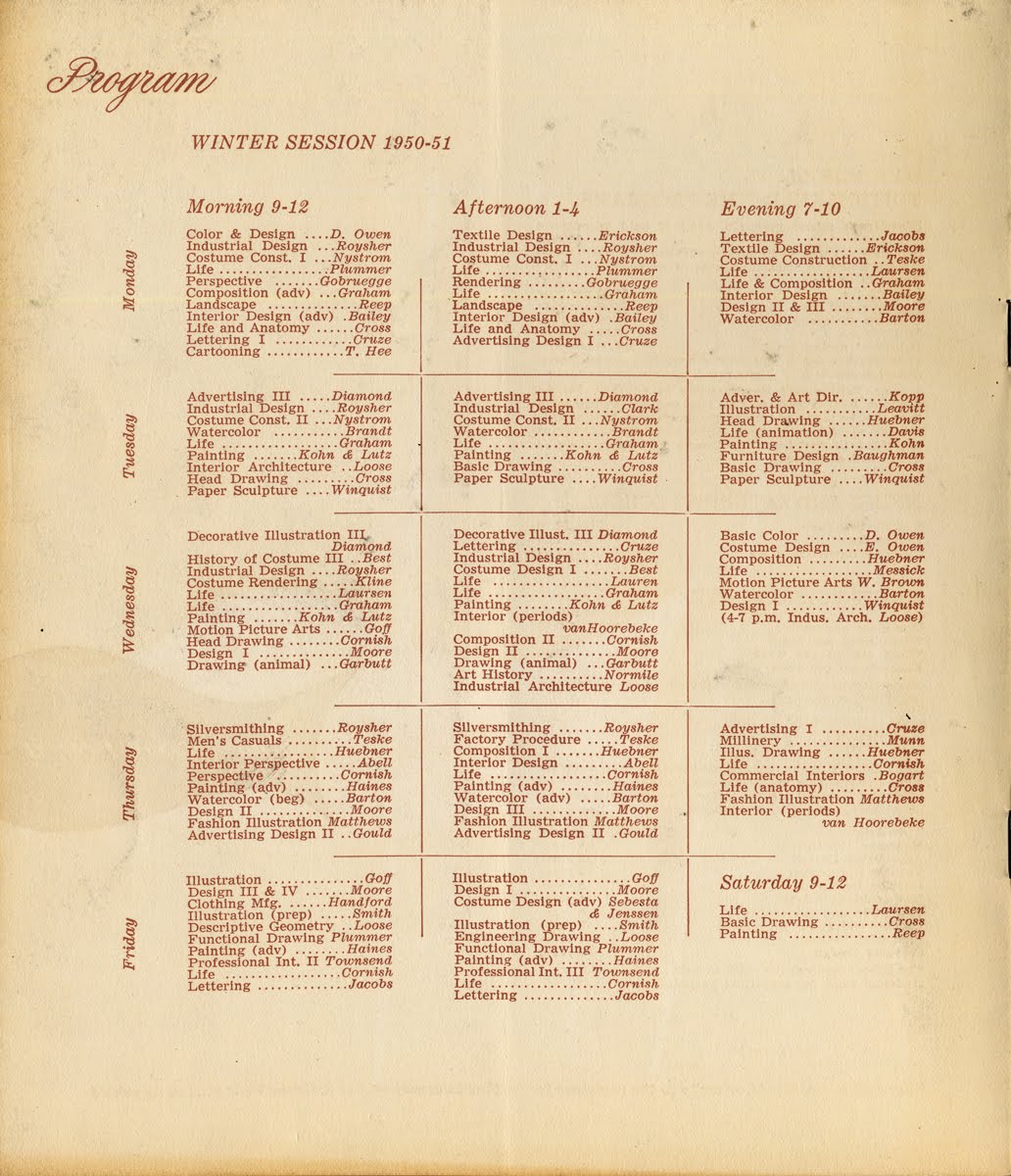
Chouinard Art Institute: Course Catalogs circa 1950

Happy 2011 New Year! It's hard to believe it's been almost two years since I wrote a post here about Chuck Jones and Chouinard where I mentioned that my Great Uncle had attended the school in the early 1950s. I had hoped to share a lot more about that story here by now, but better late than never.

My Great Uncle Dan, one of my Grandmother's brothers on my Mother's side of the family, enrolled in Chouinard after serving in the military during World War II. I believe his focus at the school was on Advertising Design and he went on to have a successful career as an Art Director in the advertising field here in Los Angeles. As I mentioned in my earlier post though, by the time I realized I'd really like to ask him some questions about his career and his schooling at Chouinard it was too late.

After he passed away in 2005, I was fortunate that his immediate family allowed me to have a few of the art books and other items from his studio space that I found interesting. Amongst these things were a couple of the Chouinard Course Catalogs from the time my Great Uncle attended the school.

I have to admit that it was pretty exciting to find these in his studio. Not only was I struck by the beautiful image of the drummer on the '51-'52 brochure, but when I looked at the class schedules and the instructors I saw more than a few important names I recognized. Names of legendary artists like T.Hee, Bob Winquist, Bill Moore, Donald Graham, and Marc Davis.

So I've finally gotten around to scanning them and would like to share the catalogs here:


Hopefully these scans will be of interest to some people, as well as acting to preserve a small aspect of Southern California's notable history in the modern arts.

Wednesday, 24 November 2010

Disney Model Sheet: OWL

I was about to write yet another post about an observational sketching book, but then I thought maybe I should post something fun and cartoony before the Thanksgiving Holiday. Well here it is, a model sheet of the Owl teacher from the Walt Disney shorts "Toot Whistle Plunk and Boom" and "Adventures in Music: Melody". Enjoy and have a great holiday!

Thursday, 4 November 2010

E.H. Shepard: The Man Who Drew Pooh

I briefly mentioned E.H. Shepard in a post I wrote about Hayao Miyazaki here in 2009. E.H. Shepard was an English artist and book illustrator who is probably best known for the illustrations he did for A.A. Milne's "Winnie the Pooh" series of books, which were published in the late 1920's. Shepard's drawings are charming, delicate, and exhibit an incredible facility in draftsmanship.

I recently purchased a book about him called "E.H. Shepard, The Man Who Drew Pooh" by Arthur R. Chandler. I haven't had the chance to read much of the book yet, but the text seems to be mostly focused on cataloguing the chronological events of E.H. Shepard's life and career. There might be a few gems of artistic knowledge or insightful quotes by Mr. Shepard in the book, but I haven't found them yet. However, one thing is for sure, the book is filled with quite a bit of his drawings which are definitely worth seeing for anyone who likes Shepard's work. I scanned in a few drawings from the book and would like to share them here.

This first drawing is titled Man with wheelbarrow, a pencil sketch done in 1924. It's a fantastic drawing, no analyzation needed really. It's well observed and beautifully drawn.


I apologize if the recent theme of my posts have been too centered around observational sketching/Life Drawing, which can seem like a boring subject, but it's a subject that I've been inspired by this year and I think it's something that we all could do a bit more of. Observation helps to inform our work and hopefully keeps us from being formulaic.

This next illustration is a Christmas card that Shepard made in 1943. There's a lot of great things going on in this illustration. The design and use of black space versus empty white space, and the patterns and textures he has used to create the "grey" areas, but I especially love the figure of the soldier holding the gun on Santa. It's a tremendous drawing.


Next I scanned a couple of rough sketches that Shepard did for The Secret Garden. It's nice to see some more pencil drawings, as opposed to the more common ink drawings, from him and to get an insight into his illustration process. The figures are beautiful, but I also admire how he indicated the backgrounds. There's a nice tree/grass vignette behind the girl in the first image, as well as another wonderfully rough and simple indication of the door and long gallery stretching beyond her in the second image.


Last but not least, here's a couple more charming observational drawings that Shepard sketched of a woman on a train. Again in pencil.


There's a lot more drawings than these in the book, but I wanted to present a few here that I thought were especially nice. I'll try to do another post later on Shepard and a few of his children's book illustrations from some of the less well known titles.

Maybe I have mentioned this before, but hopefully you might have noticed that I've been presenting the artwork on these posts in the 8 1/2" x 11" format where possible. So if you find something inspiring you can easily print it out. I am a little less busy at work now, so I expect I can do a few more posts on some other interesting books that I've picked up recently before the end of the year. Stay tuned.

Wednesday, 27 October 2010

Robert Fawcett : Drawing the Nude 2

A few more quotes and images from the book "Drawing the Nude - The Figure Drawing Techniques of Noted American Illustrator Robert Fawcett" by Howard Munce.

"Memory drawing is a valid method, although I will neither advocate it nor analyze it in these pages. The danger of drawing by memory is that it can and does produce images which become a formula. Instead, I want you to concern yourself with looking carefully, and recording what you see at the moment."--Robert Fawcett


"The person who sits for your drawing can have any possible ethnic background, and this must be conveyed. It should be within your ability to record and convey personal physical characteristics to others. A model may be shy or brash, vain or modest, cooperative or lazy. Even these qualities are within your province, if you have taught yourself to observe and record."--Robert Fawcett


"We must also take it for granted that there are many approaches to the teaching of figure drawing--as many as there are artists with opinions on the subject. No single point of view can possibly be the last word."
--Robert Fawcett

Monday, 16 August 2010

Robert Fawcett : Drawing the Nude

The following quotes and images are from the book "Drawing the Nude - The Figure Drawing Techniques of Noted American Illustrator Robert Fawcett" by Howard Munce.

"With practice, one comes to recognize what one is looking at as either primarily linear or tonal, and one comes also to know whether its structural characteristics are predominantly angular or rhythmic. It is upon this one bases the
statement, for that is what a drawing is - a simple, pictorial statement." --Robert Fawcett


"Bob Fawcett always simplified form in his drawings. He once said, "Economy in drawing is essentially the shorthand which develops in the excitement of the fleeting moment. It is the thing seen subjected to editorial exclusion." However, he tried to avoid slipping into superficiality: "One's study can be admired for it's beautiful line, but if that line is not expressing an understanding of the form itself it remains mildly interesting, but empty of content.""


" I am convinced that divisions of subject matter in drawing are arbitrary. Although largely devoted to the figure, my work has included subjects ranging from figures to still lifes to landscapes. Drawing is drawing. There is no such thing as figure drawing, per se. In writing this book, I seem to be engaged in a project which threatens to contradict that belief. Actually it will not. Although I am concerning myself here with the human figure, life drawing alone, in the background there remains my belief that an apple and a flower are equally difficult to draw, and a deer, perhaps only more difficult." --Robert Fawcett

Wednesday, 5 May 2010

Murakami Yutaka & Yoichi Kotabe

On my last trip to Japan in 2010 I bought quite a few books. Here's a couple images from them. These are only two of the many artists I've found to be interesting and inspirational from Japan. Murakami Yutaka works in the field of illustration and Yoichi Kotabe worked in animation.

Murakami Yutaka


Yoichi Kotabe


I really like the simplicity, as well as the rough and organic quality in both of these artist's work. Hopefully I can get to posting more here about these particular artists as well as some of the other interesting artists and books I found in Japan as time goes on.

Tuesday, 9 March 2010

Peter Pan Model Sheet: Mike

Here's another model sheet I like from Walt Disney's Peter Pan. Some people might say he's just the typically cute and generic Disney kid, but I think there's a lot of great things going on in these drawings. The simplified indications of his body poses are very appealing to me. Especially when it comes to the shapes of his hands, legs, feet, and the way drapery of his pajamas is handled. There's a lot of nice contrasts between straights and curves, as well as the simple sides of the shapes versus the more interesting and complex sides of the shapes. It's interesting how the drapery of his pajamas tends to play a big part in many of these nice contrasts.

The drawings of Wendy here are beautiful as well. Unfortunately I'm not sure which artist at the studio drew these, but I think they're worth taking a closer look at.

On a side note, but an important note nonetheless, fellow DreamWorks story artist Louie Del Carmen has recently written a great post about composition on the Art Center Blog.

Here's the link:

http://theartcenter.blogspot.com/2010/03/louie-del-carmen-rhythm-and-spacing.html

Tuesday, 26 January 2010

2 Websites

Well, it's been quite a while since my last update, but I still have a lot more things that I'd like to share. It's just a matter of finding the time and making the effort to do it. Time management has never been one of my strong suits unfortunately.

I'm not going to make any excuses or promises that I can't keep this year though. Actions speak louder than words. All I can say is that I don't plan on abandoning this site any time soon. Subscribing to this blog will probably be your best bet to know when it's updated though.

I'd like to start off 2010 by sharing a couple websites that I've found to be pretty useful and interesting.

The first site is http://books.google.com/. I realize that I've probably arrived late to the party on finding out about this one, but I thought that it's definitely a place on the internet that's worth taking note of as a research tool. Especially since I recently found a full version of the book Composition by Arthur Wesley Dow available for download on the site.


I haven't given up on my research into the design program at Chouinard, and this author was one of the people that was mentioned in the book Chouinard: An Art Vision Betrayed, as having had a big influence on some of the design instruction and people at the school.

The second site I'd like to mention is http://howtotrainyourdragon.tumblr.com/.


DreamWorks has put together a great site with some nice interviews of quite a few artists who worked on "How to Train Your Dragon". I don't know how many people know about this site yet, but it's really cool. I found the interviews with Production Designer Kathy Altieri, and the film's Head of Story, Alessandro Carloni (who I was lucky enough to work with on the movie), particularly inspiring.

Thursday, 5 November 2009

Milt Kahl: Hands


Here's a model sheet of hands drawn by the legendary Disney animator Milt Kahl. These have a dynamic combination of anatomical knowledge fused with great graphic appeal and shape.

Friday, 30 October 2009

Ernest Watson: Drawing Trees

After my Great Uncle passed away in 2005, his immediate family allowed to me to have some of the books and magazines that were in his studio workspace. Some of the more interesting things I was able to get were a few issues of The Journal of Commercial Art and American Artist from the late 1950s.

Here is an article Ernest Watson wrote for American Artist - Special Summer Issue - June - July - August 1956. It covers a few topics on pencil sketching, but I edited it down specifically to what he wrote about drawing trees.

Friday, 23 October 2009

Chapter 8: Drawing


"Drawing is the language that enables the men of the Ice Age, in the caves at Altamira in Spain and Lascaux in France, to speak to us, today, and to the men of the hundreth century, with perfect clarity. Drawing is the universal language. Draughstmen communicate instantly and effectively with anyone, anywhere in any time."

An inspiring quote from the book "Complete Guide to Watercolor Painting" by Edgar A. Whitney. I'll definitely post more about this great book in the future. The images are from the Lascaux caves in France.


Tuesday, 13 October 2009

Original Tinkerbell Model Sheet

I apologize for the lack of recent updates. I've been pretty busy at work as well as in my personal life.

Here is one of the original model sheets for Tinkerbell in Walt Disney's Peter Pan. I'm pretty sure it was drawn by Marc Davis. I don't think Milt Kahl did a pass on this character (ala Bambi or Alice), it's 100% Mr. Davis as far as I know.

When I say "original" I mean that it's her original character design. The Disney company has done many variations on her character design over the years due to her popularity. Some are good and some aren't so good, but none of them really come close to the appeal of Marc Davis' original design in my opinion.


I know that we've seen these all before, but I think they're exquisitely beautiful drawings and definitely worth taking another look at. The appeal and design of a pose is so important in animation and these poses are wonderful. I hope to do a post elaborating more about the design of a pose some time here in the future.

Even though these aren't extremely cartoony or pushed, I think there's some really fun stuff happening with her proportions here too. Her small hands, larger head, tiny feet and wider hips really play off each other and contrast in an interesting and appealing way. I also think Marc Davis' knowledge of the human figure really shines through in these designs as well.

I wish I had a better copy of it, but this will have to do for now. Hopefully I can do another update here sooner rather than later.

Tuesday, 29 September 2009

Hill Farm

Here's another animated short that I really enjoyed seeing at animation festivals while I was younger.

It's a film called "Hill Farm" by Mark Baker.

It's fairly long for a short film, running at approximately 15 minutes, but if you have some time to spare I think it's really worth watching. The animation in this film is fun, caricatured, and beautifully done. I also love the fact that there's not a word of dialogue in the short, only the sounds of the animals, props, environment and the music.

Thanks to Minkyu Lee for sharing the link with me.


Tuesday, 25 August 2009

Richard Condie

I really love these Richard Condie films. Seeing his work at animation festivals while I was growing up was a big inspiration for me.

This first film, "Getting Started", was funny to me when I was younger mostly because of all the crazy physical gags that happen in it. Now that I'm older though, I can really relate to the main character's battle with procrastination, and it's even funnier.

The second film, "The Big Snit", is also another favorite of mine.


Sunday, 9 August 2009

Hayao Miyazaki: Starting Point


I just bought Hayao Miyazaki's book "Starting Point" from the Kinokuniya Bookstore in Little Tokyo, here in Los Angeles. It's the English translation of a book containing articles which Miyazaki wrote for various publications, transcriptions of his spoken lectures, as well as some interviews with him where he shares his thoughts on Animation, Filmmaking, Current Social Issues, and more. Here's a picture of the original book that was published in Japan along with a photo of Miyazaki himself:


It's a tremendous opportunity to be able to finally read the thoughts and philosophies of a modern day master in English. Kudos to Viz Media for translating and publishing it. 'Nuff said.

Thursday, 6 August 2009

Christophe Blain and a few other things...


I was initially introduced to the fantastic comic book work of Christophe Blain by my fellow artists on the "Up" story team a couple years ago. Since then I've purchased pretty much every comic that he's done which has been translated from French into English.

A few months ago though, I was chatting with Louie Del Carmen about Mr. Blain's work and he brought in a couple books that Blain had done which I had never seen or heard of before. I was blown away.

"Carnet de Lettonie" and "Carnet Polaire".

"Carnet de Lettonie" is my favorite of the two. Here is the cover and a few images from inside:


The book is basically a collection of Blain's amazing sketchbook/reportage drawings. Unfortunately, since I can't read French, I don't really know what the theme of the book is. The drawings in the book are exquisite however, and there's quite a lot to see on every page too since the book is mostly artwork, not text. Blain's command of light and dark values, as well as his use of pattern and texture, especially in his landscapes is incredible. He also changes what media he uses a lot from sketch to sketch-- using a brush with ink, pencil, fountain pen, watercolor, sometimes even some crayons. I've been trying to do more observation sketching myself lately, so this book has been a great inspiration for that.

The other book,"Carnet Polaire" is very similar to "Carnet de Lettonie". But there's a lot more text in french, which I can't read, and it seems to be exclusively focused on a trip that Blain took to the south pole. Here is the cover and a few images from "Carnet Polaire":


This book is awesome too. What I like the most about Blain in these books, beyond his ability as a draftsman and painter, is that he's always experimenting and doing something different. He approaches things in so many different ways, with so many different types of media. He never seems to get stuck in a formula or a rut. His work is always fresh and always different from one page to the next. His ability to capture things he has observed is organic, lively, and honest.

These two books are available to purchase at Stuart Ng Books, or Amazon.fr for those who can read french well enough to order them.


The next recommendation I have is for a DVD I purchased a while ago, and finally got around to watching recently. The DVD is called "The Cutting Edge - The Magic of Movie Editing".


This documentary is basically a series of interviews with Film Editors and Directors, covering the history of editing as well as it's vital role in making a film. It's not perfect, but I think there's enough interesting information in it to give it a recommendation. Watching Walter Murch cut together a sequence for the film "Cold Mountain" was the highlight of the documentary for me.


Finally, I wanted to mention an artist's website that I was introduced to recently-- Rodolfo Damaggio. A live action film storyboard artist. Click on his name above to visit the site.


Although I'm personally more inspired by his drawings than his paintings, there's no doubt that he's a phenomenal artist. There's a lot of great work on his site that is worth checking out, especially in the Storyboards section.

Thursday, 23 July 2009

Some Great Interviews

A friend introduced me this website recently: http://animated-views.com/
It has quite a few interesting interviews with some of the best artists working in the field of animation today, as well as with a few legends from the past.

Clicking on their names here will link to the interviews.

Alice Davis talks about her husband Marc Davis' work.


Burny Mattison also talks about Marc Davis' work.


Joe Moshier talks about his work at Disney and his move to DreamWorks.


James Baxter talks about working on "Enchanted".


Pete Docter talks about "Up".


Jan Pinkava talks about his history of working at Pixar on "Geri's Game" and "Ratatouille", as well as his future.


Enrico Casarosa talks about storyboarding on "Up", "Ratatouille", and his personal comic work.
Part 1
Part 2


Henry Selick talks about Joe Ranft, "Moongirl", and "Coraline".

There's a lot more on the website. Please check it out.